NRT Trainees Lead Summer Camp Introducing Students to AI for Engineering
By Emma Bennett
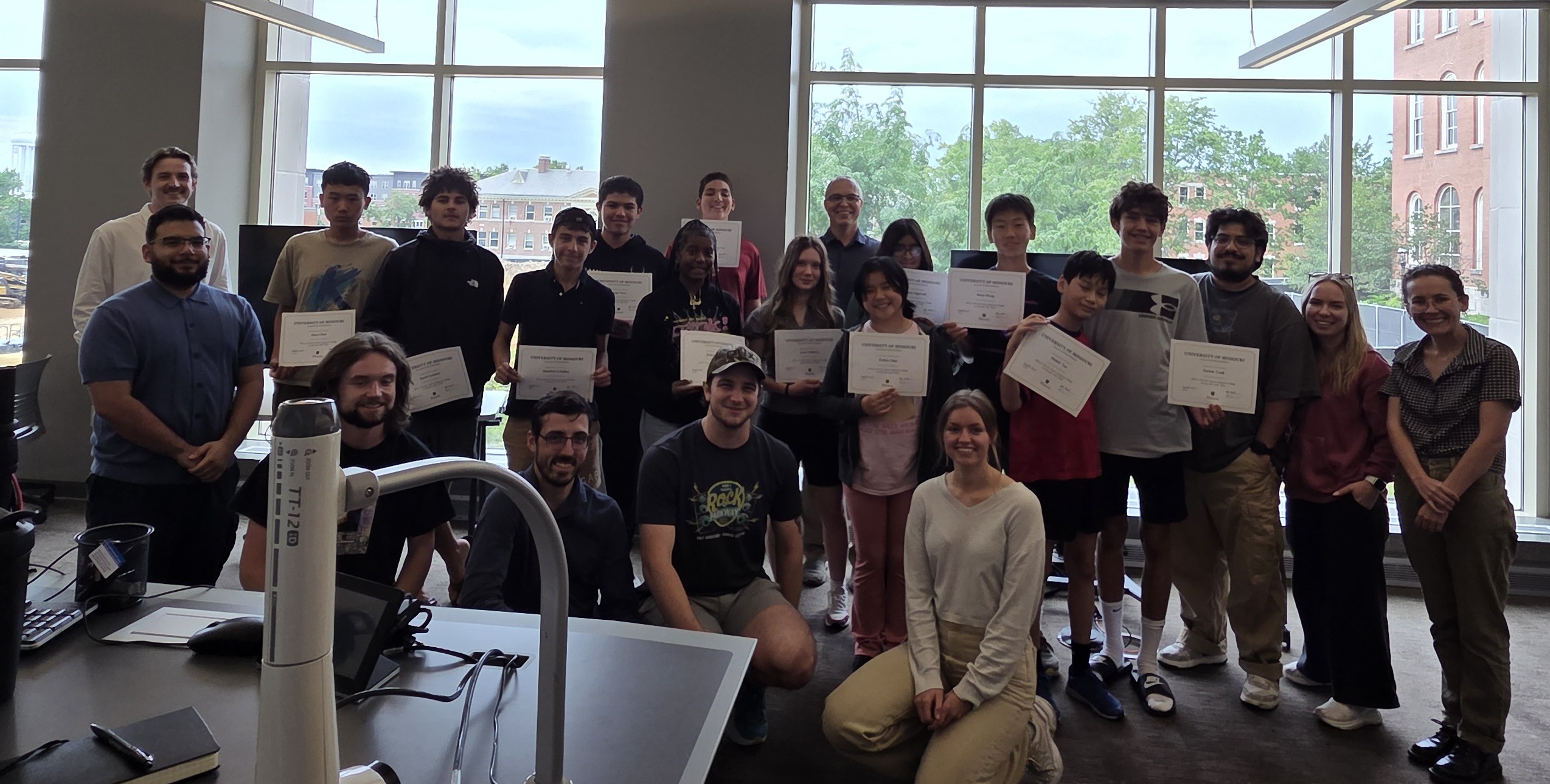
The University of Missouri NSF Research Traineeship in AI for Materials Science hosted a summer camp, AI as a Tool for Future Engineers, the week of July 6–10, 2026. Over five full days in Lafferre Hall, middle and high school students learned to apply machine learning to authentic engineering problems, toured active research laboratories, and completed team capstone projects presented to their peers and instructors on the final afternoon.
The camp was designed and taught by NRT trainees, who developed the curriculum, wrote the instructional notebooks, and led daily instruction.
Program goals
The camp was built on a straightforward premise: students do not need advanced programming experience to use artificial intelligence as a tool for engineering discovery. Instruction therefore emphasized engineering judgment over syntax. Participants used an AI coding assistant to generate, modify, and debug their own programs, while the curriculum concentrated on the decisions that surround the code.
By the end of the week, participants were expected to be able to:
- Distinguish between artificial intelligence, machine learning, and traditional programming, and identify where each is appropriate
- Apply a ten-step machine learning workflow to a defined engineering problem
- Select and interpret performance metrics appropriate to a given modeling task
- Critically evaluate AI-generated code and model output rather than accepting it at face value
- Communicate methods, results, and limitations to an audience
The emphasis on critical evaluation was deliberate and ran through every day of the program. Students were repeatedly asked to assess whether a model's output was physically reasonable before accepting it, and to diagnose the cause when it was not.
Curriculum
Monday — Foundations. Participants configured accounts and development environments, were introduced to notebook-based programming, and worked through the distinctions between programming, artificial intelligence, and machine learning. The day's applied session addressed chemical property prediction, including boiling point, melting point, vapor pressure, oxidation potential, and pKa. Instructors provided partially completed notebooks so that students would encounter and resolve genuine implementation problems. The capstone competition and its candidate project topics were introduced in the afternoon, and capstone groups formed.
Tuesday — Data collection and carpentry. Instruction covered data types, missing and anomalous values, distributions, variability, and correlation. Students worked with deliberately noisy datasets, produced exploratory visualizations, and examined how data quality constrains achievable model performance.
Wednesday — Algorithms and training. The day progressed from classification and regression through clustering and dimensionality reduction, with error metrics and model interpretation integrated throughout rather than treated separately. Students also visited the laboratory of Dr. Derek Anderson, Naka Endowed Professor of Electrical Engineering and Computer Science and a co-principal investigator of the traineeship, for a research demonstration.
Thursday — Workflow and optimization. Participants worked through the ten-step data science and machine learning loops in full, using an engineering conductivity demonstration as a running example: defining the goal, specifying inputs and outputs, collecting and cleaning data, modeling, analyzing performance, and iterating. Laboratory visits included a robotics demonstration and the Nanoscribe two-photon lithography system.
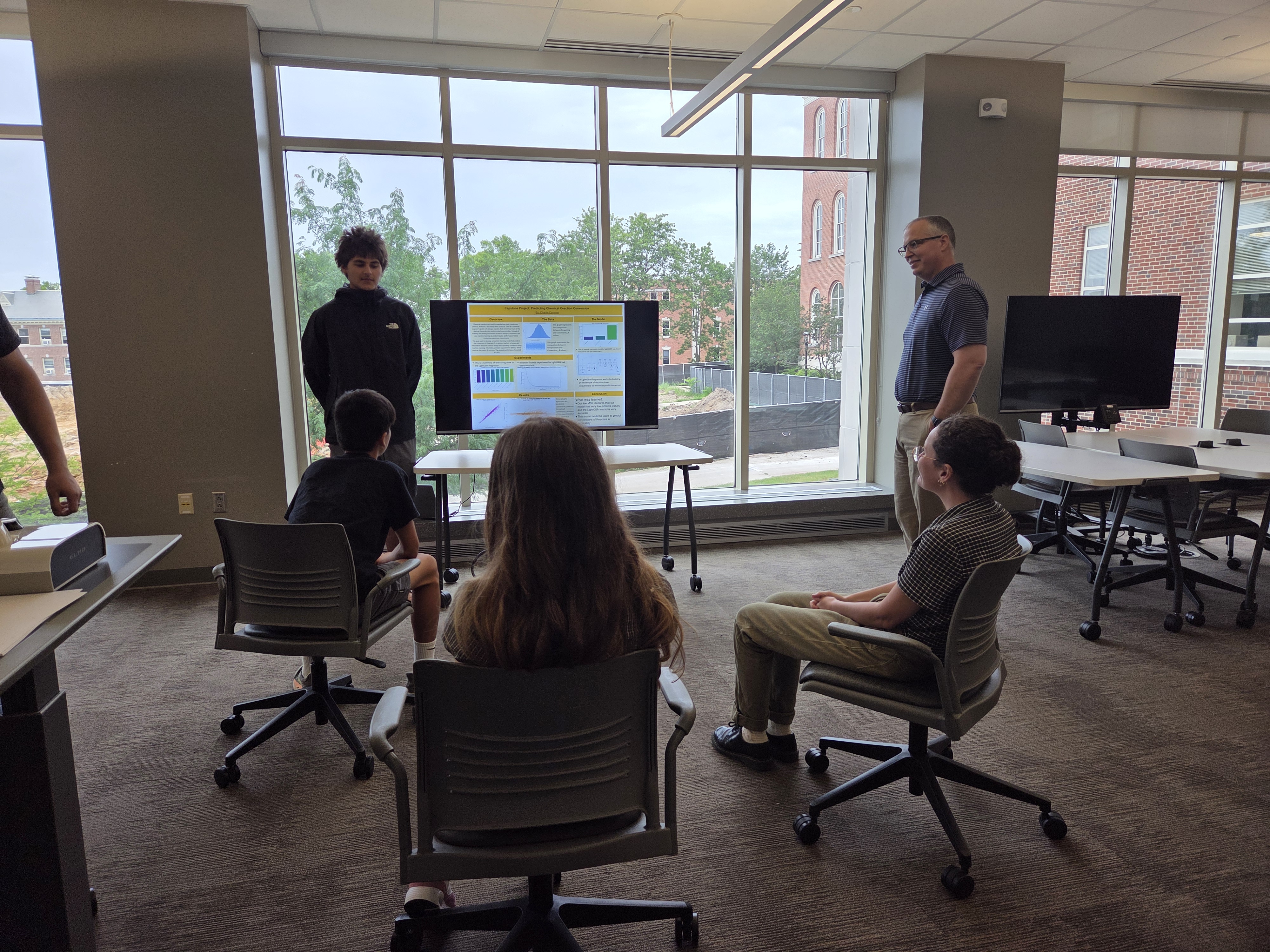
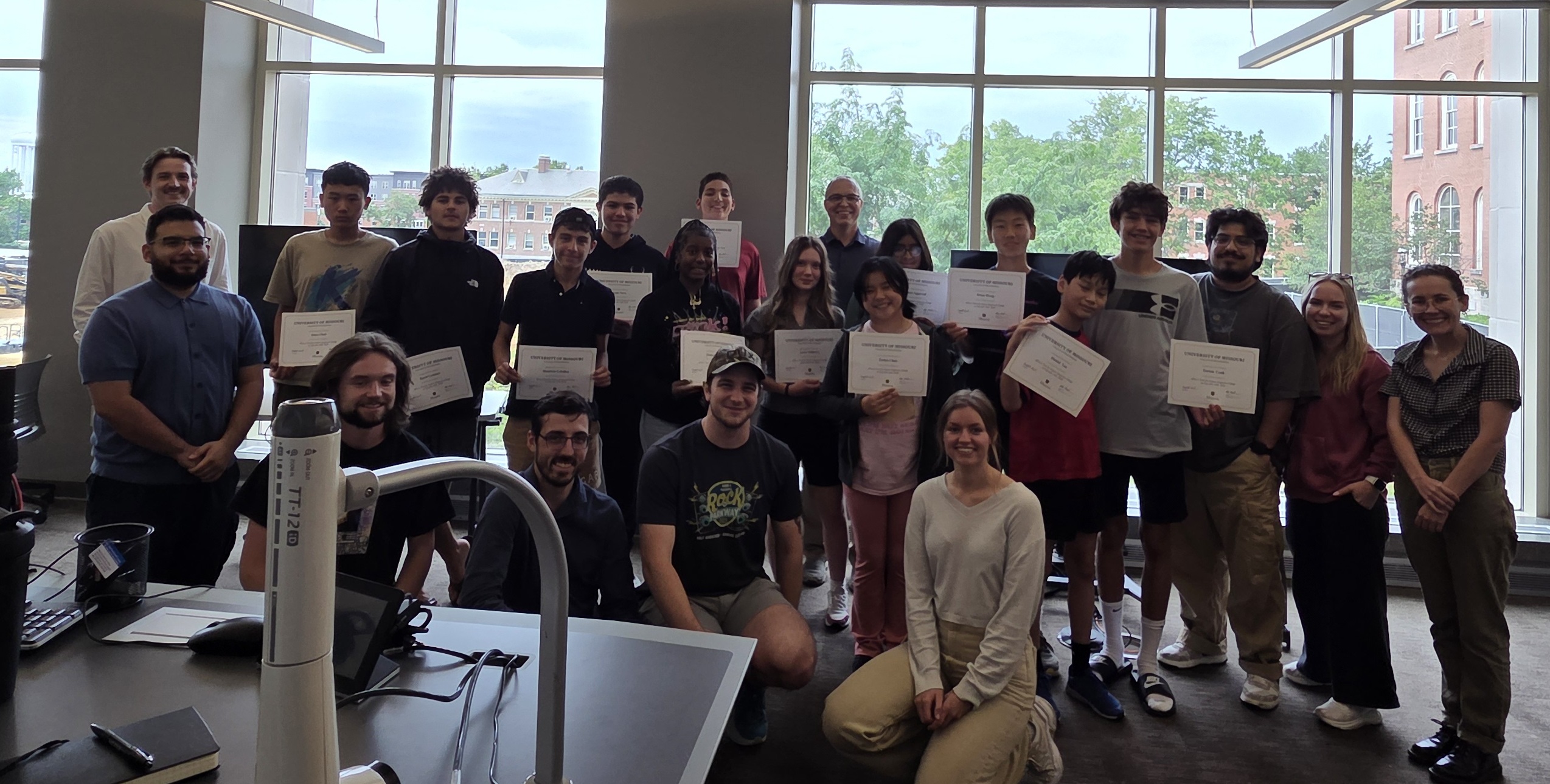
Friday — Capstone projects. Students carried a project end to end in a single day, selecting from a set of real engineering datasets spanning chemical reactor conversion, image classification, medical diagnosis, jet engine performance, and air and water quality. Each student defined their objective, prepared its data, engineered features, selected and tuned an algorithm, and presented results. The week concluded with student presentations, an awards ceremony, and the presentation of certificates.
Outcomes
The final presentations served as the camp's primary assessment. Students were asked not only to report their results but to explain their modeling choices, justify their evaluation metrics, and discuss the limitations of their approach — including what had not worked and what they would attempt with additional time. Participants who had opened a computational notebook for the first time on Monday were, by Friday, articulating why a model had stopped improving and what they had done to diagnose it.
Instruction and support
Instruction was delivered by NRT trainees across five days, with a designated lead instructor and team for each day: Campbell Sweet, Lucas Kuehnel, Emma Bennett, Mary Richardson, Carlos Garcia, Erick Gutierrez Monje, Ethan Mick, Simon Fernandez, Talon Hanssen, and Brendan Young. Program logistics, including registration, participant forms, accommodations, meals, and computing accounts, were coordinated by Kate Reuter.
The traineeship is evaluating the camp for future offerings, with revisions to the technical setup and an expanded schedule of laboratory visits already under consideration. Educators and organizations interested in partnering on future outreach programming are encouraged to contact the traineeship.